The Build vs. Buy Matrix.
Every AI engagement begins with the same question: should this capability be configured from a tool you already pay for, built inside your team, bought from a vendor, or commissioned as a system that does not yet exist? We answer that question with a 2×2 — and because we deliver in all four quadrants, the answer is chosen by fit, not by what we happen to sell.
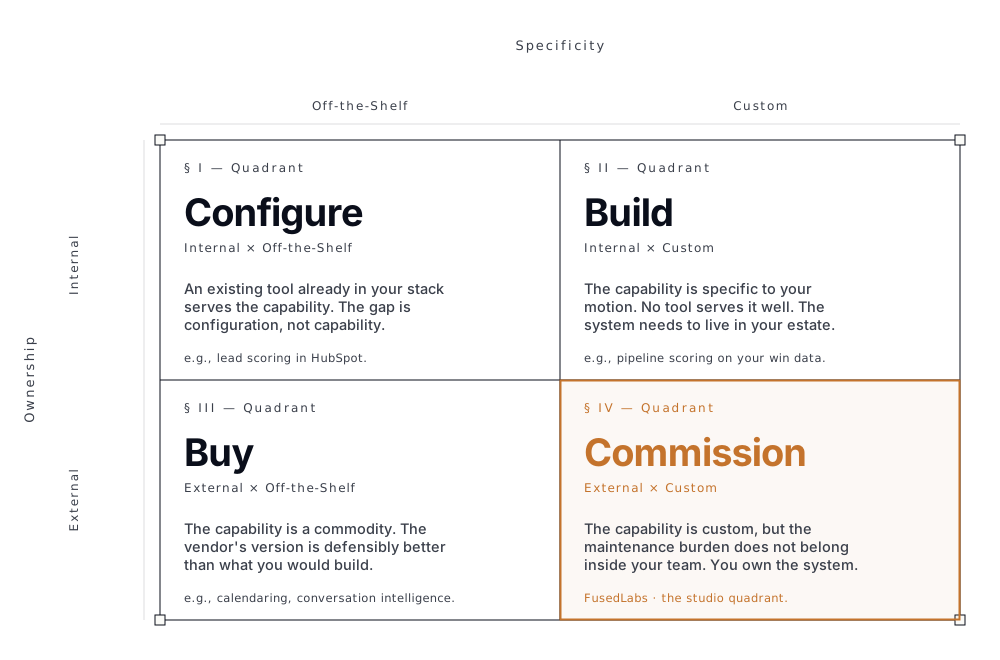
Two axes. Four answers. One framework.
Most firms answer the question with whatever they sell: consultancies recommend advice, vendors recommend software, agencies recommend retainers. We work across all four quadrants, so the recommendation carries no house bias — the quadrant is chosen by the task.
One studio. All four answers.
The matrix is not a sales device that funnels every capability toward the quadrant we monetize. Each disposition maps to work we do.
Quadrants I and III are typically scoped under the consulting engagement. Quadrants II and IV run through the engineering motion — Blueprint first, then build. The diagnostic decides which quadrant each capability belongs in before either engagement is scoped.
Most stacks are over-indexed on Quadrant III and under-indexed on Quadrants II and IV.
The diagnostic finds the imbalance. The Blueprint corrects it. The build executes the correction. And when the right answer is a tool you already own, the brief says so — a firm that only recommends what it builds is a vendor with better typography.
What is the Build vs. Buy Matrix?
The Build vs. Buy Matrix is a decision framework for AI capability investments in a B2B SaaS revenue operation. It maps candidate capabilities onto two axes — Internal vs. External (who operates the system after deployment) and Off-the-Shelf vs. Custom (whether the capability is general-purpose or purpose-built for the company's specific motion) — to produce a written disposition: configure, build, buy, or commission.
The framework is designed to replace anecdotal vendor decisions with a document the CFO can underwrite and the CTO can ratify. FusedLabs delivers against all four dispositions: configuration work and vendor decisions run under its consulting engagement; custom systems — built in the client's estate or commissioned and transferred on day 91 — run under its engineering engagement. Because the studio is not confined to one quadrant, the disposition is selected by best fit for the capability, not by the seller's business model.
Reading from the studio.
The build-vs-buy decision is upstream of everything else; these notes cover how teams adopt AI and the GTM thinking that determines which systems earn the investment.